Saturday, 25 November 2017

Zen and the Art of Conscious Relationships


Some might cringe when they hear the term ‘conscious relationships’, and this is understandable, it can seem like a bit of a pretentious term, but it is actually a very important term and one that is incredibly apt in its definition. So being conscious means that we are aware of what is happening around us, and of course, of the relationship which we are in. Hence, we are aware of our relationship, what is happening within it and how we act within it.
Image result for conscious relationships
I am not the best person to be talking about this topic as I have many failed relationships behind me…in some I have been the problem, and in others it was the other person. But from these previous relationships, I have learnt something from each one. I have learnt how I act and react in certain situations, what programs of conditioning have played out over the course of relationships, and what patterns of conditioning were learnt over time. But, the main thing is that I have learnt lessons from these relationships and have done my best to not replay past programs or patterns, but to be conscious of them so I can better the relationship I am currently in.
Related imageIn relationships, individuals can be quite selfish even if they do not mean to be. It seems that many people are in them until the partnership no longer serves them in some way and then they will move on. This can be fair enough, because sometimes the other person is just not right for you and the partnership will not work, so as a result parting is inevitable. Other times, the other person might match you in all conceivable ways and you are great as a partnership. But, always in relationships, we are challenged, and sometimes when we are challenged, we as humans like to turn the other way. Because, challenges can be hard and we want easy. We want to remain in our zone of comfort and not feel uncomfortable. Although as we know, growth occurs through adversity. In adversity, the challenge (whatever it may be) when it is confronted can allow us to grow as individuals. Challenges in any form are an opportunity for us to grow and evolve. When we are in that great place with someone, but we come up to a speed bump, don’t let that speedbump define the relationship, speedbumps will always be there so see the speedbump as a challenge to be overcome to allow growth.
When two people are in a relationship and an issue arises, if either party is not aware of what is happening and complications arise as a result a result of the issue, things could snowball fairly quickly, and before you know it a verbal fight could ensue. This is why it is so important to nurture a relationship and to allow it to be healthy through awareness of what is happening. A relationship can be a great opportunity for transformation and growth, and we can learn the most about ourselves in them.

In a healthy, conscious relationship, there are certain principles that need to be followed for us to allow the relationship to grow and to allow for our own continued growth on a personal level. These principles need us to be self-aware of the conditioned programs that we run in ourselves and also those repetitive cycles that we have played out in previous relationships. It is important and necessary to have an environment of honesty where all feelings are not hidden and are shared with your significant other. These feelings do not always have to be of the happy and positive variety, and more often than not they won’t be…anger, sadness, fear… all is fair game. As they say, sharing is caring! We also need to be self-aware and notice our feelings and thoughts, and share them with our partner. Finally, we need to realise that our Integrity is essential. It is so important that we say what we do and we do what we say. We need to follow through on our words or our promises.
Image result for conscious relationships
Be awake and aware of who you are and the relationship you are in. This nurtures you as a person and the relationship you are in. Only growth can come from this.


Yours in health,

Ben :-)

Monday, 6 November 2017

Samurai warriors, universal connection and how to realise our purpose in life.

Female SamuraiThe Japanese have a certain way with words… they can evoke feelings of strength, honour and loyalty. This has much to do with Japanese culture and their own code of morals and of the traits that they think are important for an individual to have in life. The meanings of their words and the terms they use have a romantic sense to them also, they can convey mystique and entire concepts which can paint a picture in your minds’ eye.  Much of Japanese culture can be attributed to the feudal system of medieval Japan which arose at the collapse of aristocratic rule in approximately 1400 AD and lasted for roughly 200 years. During this period, a relative age of chaos was ushered in which was appropriately called The Warring States period. It was during this time that samurai warriors came to the fore and fought for the honour of their state, their master and most importantly their lord. The samurai warriors were known as bushi (warrior) and the creed that they lived by was called Bushido (Way of the Warrior). Bushido is a rigid value system of discipline and honour that required the samurai to live and die in the service of their lords. Much of this way of life (minus the act of seppuku or ritual suicide as it is known) from feudal times has remained in the collective consciousness of the Japanese people, and is inherent in their way of life, their speech and their language- although the act of seppuku is still used in organisations such as The Yakuza where dishonour is frowned upon and does result in ritual death.

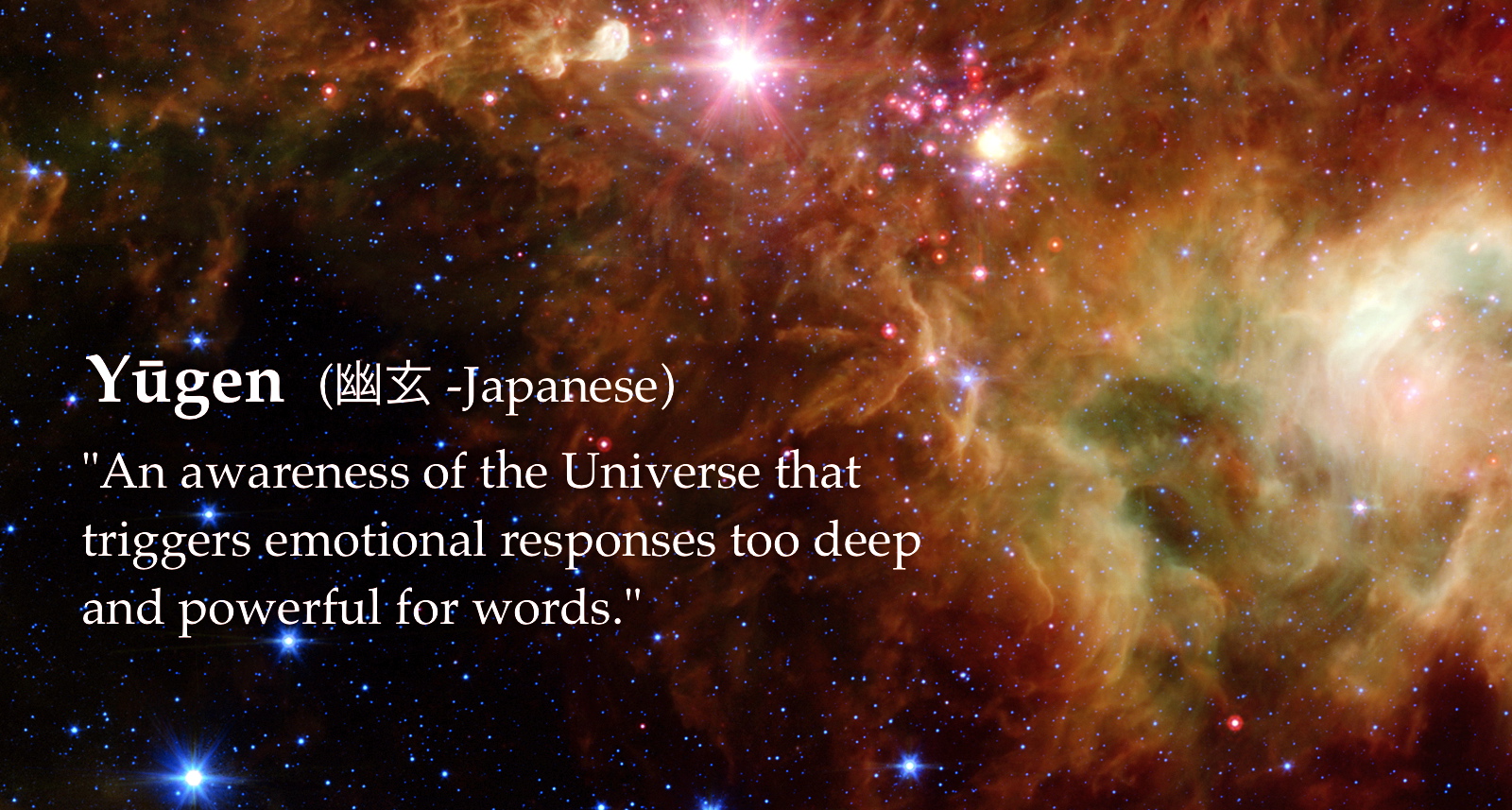
Image result for yugenThere are two particular concepts from Japan that encapsulate the Japanese way of life, Zen teachings and the elemental forces that can be found in universal connection. These concepts are very beautiful, and in a very succinct manner, and without being too verbose or wordy cut right to the core and explain simply and easily the purpose of life. These two words, which both convey entire concepts are Yugen and Ikigai. If you know anything of Zen Buddhism, you will perhaps know the concept of Yugen. Zen Buddhism lies at the heart of Japanese culture, and has its roots in the awakening of Siddhartha Gautama, also known as The Buddha, 2500 years ago. In essence, Zen Buddhism is a method of self-discovery which is found through meditation, as well as the experience of presence that is found by living in the present moment. Japanese ideals are heavily influenced by Zen Buddhism where all things are considered to be either evolving or dissolving into nothingness- although this nothingness is not an empty space, but a space of potentiality. Through this process of self-discovery through the practices of meditation and experiential living we also realise that we are most alive and connected with the elements around us. Hence Yugen. Yugen is an awareness of the Universe that triggers an emotional response which is too deep and powerful for words. It is an innate connection with the universe and all within it, a knowing that we are a part in the inter-connectedness of all things and an active part of the Universal Consciousness. Yugen applies to our experience in this world and in this lifetime, and this implies that we are aware of our spiritual connection to all things.

Image result for ikigaiSecondly, we have the word Ikigai. This word is comprised of two separate words which are iki which refers to life, and kai which roughly translates to ‘the realisation of what one expects and hopes for’.  Ikigai therefore translates to ‘our reason for being’. To get to the point where you find what your reason for being is, you will need to bring together four principal areas of our life which are namely our passion, our mission, our preferred vocation and our profession. Ikegai is the space that is found at the intersecting point (imagine a Venn diagram), and is seen as the source of value that makes one life truly worthwhile, or the reason why we get up in the morning. The word is more often used to refer to the mental and spiritual state behind our circumstances, and does not really take into account financial status to a large degree. Ikegai is often a response to natural and spontaneous actions that emerge from a deep and direct connection to life at large and the world around us. This is our life purpose. In Japanese culture, everyone is thought to have an ikegai, but to find it can require deep enquiry and introspection; a search of self which is highly regarded.

So, both of these concepts give us the ability to connect to the universe in a very deep, natural and organic way, which can make us become more motivated and proactive in our day-to-day life. The process of understanding these concepts and bringing them into our life can allow us to understand our place in this world on a microcosmic level and our place in the universe on a macrocosmic level.

Happy searching everyone!


Ben :-)

References

http://www.ushistory.org/civ/10c.asp
https://creativesystemsthinking.wordpress.com/2014/12/13/yugen-%E5%B9%BD%E7%8E%84-deep-awareness-of-the-universe/
http://upliftconnect.com/ikigai-finding-your-reason-for-being/

Thursday, 2 November 2017

The Fear response, prehistory, realising potential and other wonders…


Image result for amygdala and fearThe slayer of dreams, the denier of possibilities, the vanquisher of authenticity .The killer of potential. Fear; we know what it is and we have all experienced it at some point in our lives. Some have overcome this monster and others have shied away and run in the opposite direction. Why is this? Why do some people view fear as a challenge and something to be overcome, and why do others cower in the face of it? A very interesting question. The emotion of fear is attributed to the primal part of our brain- the amygdala- and this is a component of the limbic system which is responsible for the processing of emotions. This region of the brain which is part of our ‘primal brain’, is near the base of the brain stem, and in times gone by it was this part of the brain that was primarily used. Since these prehistoric times and during the course of evolution, our brains have become more involved and much more complex as well as much bigger. This is why the area known as the amygdala is involved in the fight or flight response…because in these prehistoric times stoneage men and women literally had to fight or run for their food or for their lives to survive!

Anyway, back to the current day, and the amygdala still plays a hugely significant role in our lives. Our DNA and our brains have held on to these primitive parts of our ancestry and they are very much a part of who we are, and this is evidenced by our emotional responses. Fight of flight… The most basic response mechanism that is possible. Should I stay and face the adversary or should I run in fright. Our reaction in this situation will prove our mettle as a human being. What are we made of? Will we do what we would want to do and face the scary ogre in front of us, or will we not be able to stand up to the challenge?  For us homo sapiens in the modern age, The way in which this response presents itself is not so much in terms of our mortality, but more so in the acceptance of personal feats and challenges. Will we rise to the occasion, face our fear and overcome it, or will we back down in shame. This is a very pertinent question.

Image result for realising potential quotesYou see, in the modern age and especially in this age of expanding consciousness, more and more people around the globe are awakening to the way in which the corporate system operates and realising that they are just a cog in a relentless machine. When this realisation dawns, the cogs (no pun intended) begin to turn and a thought process begins from which there is no turning back from. We are working for somebody else and are in a never-ending cycle of bills and getting paid and mortgage repayments that never ceases. For the majority of individuals this is fine and it is true that you are a valuable and contributing member of society where your loyalty will pay off great dividends, but for others they want out of this race and they want to run their own race where they are only in competition with themselves and the rewards are great. They can see a horizon where greatness lay in the distance and where the feeling of being in this newfound reality is almost palpable. They WANT it… But the question is how can they get there? Before they can reach this horizon a fear needs to be confronted…a fear where instability paves the road and where security is lacking. Sure, you can stay where you are and live a secure life where you will never be wanting, but will you be happy? Will you be ok with the fact that you might have a regret about that chance you never took…that passion you never followed…that horizon you never reached? I’m guessing that you’ll be saying NO, so with that in mind, you will need to face your fear, and fight instead of flee. This will be hard as it is the road less traveled; but you know that you would have met the challenge and at least given it your best shot.

Image result for neuroplasticityAs it happens, we can ‘re-wire’ our brains to reduce the feeling of fear and to inhibit the fear response. This is great, because this potentially means that we have the ability to face greater challenges! This is what is called ‘neuroplasticity’, an area of brain study where one can create new neural pathways in the brain through the act of confronting a situation in a different way and thinking about problems in new and innovative ways. The reasoning behind neuroplasticity is that through the act of not thinking in the same way continuously and creating new ways of thinking we can build new neural connections. This also makes us smarter!
Similarly, by confronting fear continuously and facing challenges regularly, they become less daunting over time because the stimulus of fear is being aroused regularly and a conditioned response is no longer as pronounced as it once was. Long story short, face challenges regularly and you will surprise yourself at what you can achieve.

 Go forth and conquer!


Wednesday, 22 February 2017

The Tao of Water


Image result for tao waterWhen interviewed by a reporter about his newly developed Martial Art, Jeet Kune Do, Bruce Lee said that we should aim to be like water. To quote this master of both philosophy and the martial arts, he said ‘Be like water making its way through the cracks. Do not be assertive, but adjust to the object and you shall find a way around or through it. If nothing within you stays rigid, outward things will disclose themselves. Empty your mind, be formless, shapeless… like water. If you put water into a cup, it becomes the cup. You put water into a bottle and it becomes the bottle. Water can flow or it can crash. Be like water, my friend’.
Why did he say this? In his philosophical estimation he likened water to formlessness, that which is yielding yet strong at the same time. He said that water is the strongest yet softest of all elements, it can fit into any container, yet can be a raging torrent and become a destroying force. In essence, water is the embodiment of the principle of yin and yang- It can be hard and strong in its raging currents and become the ultimate destroyer, or it can be soft and graceful as in the gentle flow of a stream. Be like water, my friend. In life, this same principle applies. Life can be difficult, it ebbs and flows, there are times when it seems to be coasting along nicely, and then there are other times when we hit an obstacle and cannot seem to move forward. There are many parallels between water and life, and the life of water is a very apt metaphor.


Many people in their lives use the term ‘go with the flow’ in response to someone who is perhaps a bit highly strung or a bit on edge. It can seem that this is a throwaway phrase to some, it is usually said in response to someone who is ‘bringing down the vibe’ in the room, and they are in effect being told to take it easy. This phrase has become a part of modern day vernacular, and is quite often used without thought, although it actually has a very deep and profound meaning which can benefit us all if we just listen. It means that if we adapt to the situation, things will be fine. This brings me to another fault of the modern age, and that is the lost art of listening, but I’ll leave the tangents for another time… or perhaps another blog topic. Go with the flow…be like water… bend with the wind.  These all essentially mean the same thing and that is not to go against the grain or struggle against the tide. Be one with the Universe and its surroundings and it will be fine.

Image result for tao yin yangIn Chinese culture, water is seen as the most feminine of the five elements and is therefore considered to be the embodiment of the Yin principle. The co-existing concepts of Yin and Yang are at the basis of Taoist thought, and the existence of the Universe is a beautiful dance between these lifelong partners. Yin cannot exist without Yang, and vice versa. They are two disparate polarities at opposite ends of the elemental spectrum yet perform a beautiful dance in the natural world. The Tao Te Ching which is the text that is the basis for Taoist philosophy dates back to the 4th Century BCE, and authorship is attributed to Lao Tzu. The Tao Te Ching describes the elements within Nature and their properties, as well as their interaction in the natural world… and how humanity interacts with them. These elements are Earth, Air, Fire and Water, with the fifth element being Ether - which is otherwise known as Spirit. In Taoist philosophy, femininity (the Yin principle) and which water is representative of, is not considered weak, it is actually the exact opposite, and is seen as the most powerful element due to its ability to move around any obstacle in its path without losing its essential nature. Given time, water can erode the hardest rock or move mountains. 

Life is a matter of balance and one of harmony. If we burn the candle at both ends (too much Yang energy), we get sick, and if we identify with the feminine (Yin energy) too greatly we can be seen as weak or submissive and be walked over. It is important in life to find a balance of the Yin and Yang energies within us and know the right time when to rest in each one.  With this knowledge of the spirit of water, we can see that it can either be a Yin element or a Yang element. It can be strong and unforgiving, or it can be soft and gentle. Be like water and embody the strength needed to confront life and its adversities, yet humble in this journey called life. 


Image result for lao tzu water


Life is a great adventure which takes us down many roads. Live and experience each one.


Ben.

Monday, 16 January 2017

Love, Attachment and the Self


This life is a sensory experience, we were given a physical body with which we can experience the outside world. We can touch, we can feel, we can hear, we can see. The human experience is the most precious gift that we will ever be given, and the human body in which we reside is the most complex system in the known universe.  All that surrounds us can excite the senses in some way. From a very young age these experiences have taught us that all and any stimulation or feeling comes to us from that which is external to us.  As a child, external stimuli excites us and makes us happy, we want a particular toy because we like the colour of it and we want to own it. We covet it. We become possessive of this particular thing because we view it as ours. We place value on it. We find that these external things provide us with happiness which says to us that happiness is to be found outside of us.
 
As we grow and get bigger these feelings of attachment towards external things grow within us and so do our wants and desires. As we get older and we grow, we become bolder in our discovery of the world and our explorations grow more diverse. Our wants become more complex. Our childish wants of toys and playthings are gone because we seek meaningful interaction with others. This is the natural evolution of this life and as we become more intelligent as a human being we seek relationships with those similar to us. Although, even though evolution has occurred on a particular level and there is innate intelligence involved, attachment toward the object of our desire can still remain.
Related imagePeople want to connect with others and feel connection…the spark that ignites between two people where there is mutual caring and understanding. Although there is a difference between attachment and connection, and we need to be aware of this. Human connection is a relationship where a person or a thing is linked or associated with something else. It is connection that people seek in a potential partner so they can share experiences with another who will listen to them and understand them. Attachment is borne of connection, although it can turn into something ugly when the connection turns into dependence.  In Buddhist philosophy, there are many writings on desire and attachment and the roles that they play in our lives. They say that attachment is a neediness, dependency and self-centredness, and that it weakens us as we give away our happiness to another. Whereas, Love strengthens us and we stay in charge of our own happiness. Attachment is all about me and what I can get from you, and Love is what I can give or do for you. Attachment is based in ego, and Connection based in Love. 

Ownership has been hard-wired in us since we were children when we wanted to own that toy because it looked good or was sparkly. We became attached to the toy and we wouldn’t let it go. This mode of thought has carried on through to adulthood where we still seek ownership of things. Many people enter relationships that begin with genuine connection, but eventually they can turn into a form of attachment. When this happens, one person (or both), become dependent on the other. The other person becomes a crutch or something to lean on, something which is relied upon on to get by. It is a good thing to be able to lean on a partner in times of hardship, and have somebody to help you when in need, although it is not healthy to rely on someone else for your happiness and self-worth. When your happiness is dependent on someone else and does not come from within yourself, it is a very dangerous place to be in, because you are relying on another to provide you with self-worth. True and lasting happiness needs to come from within us and we can’t rely on another to give it to us.

Image result for inner source of loveIf we find love within ourselves we do not need to get it from another, a source of love will be found that never runs out. If we do not love ourselves it can lead to many issues such as a lack of self-confidence, insecurities, jealousy and unhappiness which leads to a negative life where happiness is hard to find. On the opposite side of the coin, if we love ourselves we’ll be more confident, positive and secure in the person that we are, and we don’t need justification of who we are from others. When we are the source of our own happiness and we do find that special connection with another, the journey with them will be a much more positive and smooth ride because of the sense of self-worth inherent within.

Be kind to yourself, and find your own inner source of Happiness.

Ben.


Sources:
https://kadampalife.org/2012/02/14/love-attachment-and-desire-according-to-buddhism/

https://zenhabits.net/falling-in-love/


Sunday, 1 January 2017

Go with your gut.

Gut Health and the Brain 

There is now evidence as to why we should listen to our ‘gut instinct’ and follow the advice that it provides us. Intelligence is not just allocated to our cerebrum, it is also attributed to our stomach - which can also be called our ‘second brain’. We now know that there is an inherent connection between our stomach and our brain, with the two organs working in unison as a biological command centre.

It is important to be mindful of what we eat not just for the obvious health benefits that correct nutrition provides us, but also because of the messages that are sent to our brain when the food we eat reaches our stomach. Our brain is working all the time, from when we are asleep to when we are awake, it is literally ‘switched on’ 24/7. Our brain is the control centre which tells our bodies when to move, how to move and why to move.  All of these operations use up an immense amount of energy, and this energy is supplied via the food that we eat. The food we put into our body can be considered ‘fuel’ that propels our body forward and allows us to power on through the day. Just like the fuel we put in our cars, the fuel/food we put in our bodies differs greatly in quality. If we put a low-quality fuel in our car it will not perform at its best, but if we fill it with a high-grade fuel it will perform optimally. The same is true with our bodies: if we fill it with junk food, it will not perform at its best, but if we eat nutritionally sound foods which are found in a balanced diet, we will perform at  our best.

Image result for gut health
So, when we eat well, both our brain and our body is performing at their best due to this direct line of communication from our stomach to our brain - Happy stomach, happy mind. This direct line of communication between the brain and the stomach is known as the microbiome axis, and communication is made via roughly 100 million nerve cells that line our gastrointestinal tract. The gut and the brain communicate via the nervous system, and the immune system. The microbiome (located in our gastrointestinal tract) releases neurotransmitters (chemical messengers) which communicate with the brain directly. This pathway from the stomach to the brain comes via a neural pathway known as the vagus nerve. The vagus nerve is part of the parasympathetic nervous system and connects our brain, gut, heart and liver as well as other organs in the body.

Due to this connection between the stomach and the brain where there is a line of communication, we can see that what we put into our bodies can also affect our mental health. Interestingly, the majority of the neurotransmitter Serotonin (roughly 95%) is produced in the gastrointestinal tract, and it is this which regulates sleep, appetite, and also our moods. So when we have high amounts of serotonin in our bodies, we are on a ‘natural high’, although when we are lacking sufficient amounts of serotonin in our brain and bodies we get depressed. Therefore it is in our best interest to eat the foods that will increase serotonin production and keep us in a positive state of mind.

The functioning of our gut health, depends greatly on the amount of ‘good’ bacteria that is found within our intestinal microbiome. These ‘good’ bacteria play an essential role in our overall health and they help protect us by creating a strong barrier against toxins as well as ‘bad’ bacteria present in our bodies. They also improve our bodies’ ability to absorb nutrients from our food, and most importantly they will activate the necessary neural pathways that travel directly between the gut and the brain.

With this knowledge, we know that what we eat affects our brain chemistry, our moods and the way our bodies perform, so it is important that we start taking note of how our bodies feel when eating certain foods. The ‘cleaner’ we eat, the better we feel, so it is best to cut out or at least cut down on the amount of processed foods eaten, and especially the amount of sugar consumed. 

Image result for gut healthA great way to improve gut bacteria is by the addition of fermented foods into your diet such as kombucha, kimchi or probiotic yoghurt (just watch out for the sugar content in the yoghurt). Fermented foods are the best way to improve digestive health and create plenty of free-radical fighting good gut bacteria.  Eat more fruit and vegetables and cut back on starchy foods like pasta, rice and bread which can cause bloating. Foods have a great impact on our overall body health and eating a diet high in good whole foods whist cutting out processed sugary foods is the best way to achieve this. By eating a cleaner diet people feel better physically and emotionally and feel ‘lighter’ in their person due to a lack of heavy foods present in their diet.

Yours in Health,              

Ben,


References: